AgentForge 2026 · Showcase
What the workshop left behind
Open tutorials, an open-source teaching agent, and the research agents that teams built during the hackathon. All of it is public.
Open materials
Five tutorials
Each tutorial comes with slides and a Colab notebook that runs without any local installation.
- From chatbot to agent: an agent loop in plain sight with mini_agent, and the same agent in LangChain, Pydantic AI and DeepAgents
- Agentic memory
- A research MCP server and Agent Skills, with tests and continuous integration
- Multi-agent systems, with a self-hosted agent in Docker
- Evaluating a paper-triage agent: code and LLM-judge graders, pass@k
mini_agent 2.0.0open source
The teaching agent from Tutorial 1, released on 23 November 2026 as an open-source package under the MIT licence. It installs with one command on macOS, Linux and Windows.
github.com/Superionichuan/mini_agentHackathon showcase
Teams built research agents during the workshop and evaluated them before presenting. Their code is public.
Sanityfeatured
A multi-agent checker that finds mathematical errors in papers. The language model proposes; a computer algebra system and Lean decide.
Live site · CodeThink Twicefeatured
A brainstorming agent that helps you judge how novel a research idea is.
github.com/AgentForgeWorkshop/Trio-s-agent-Think-Twice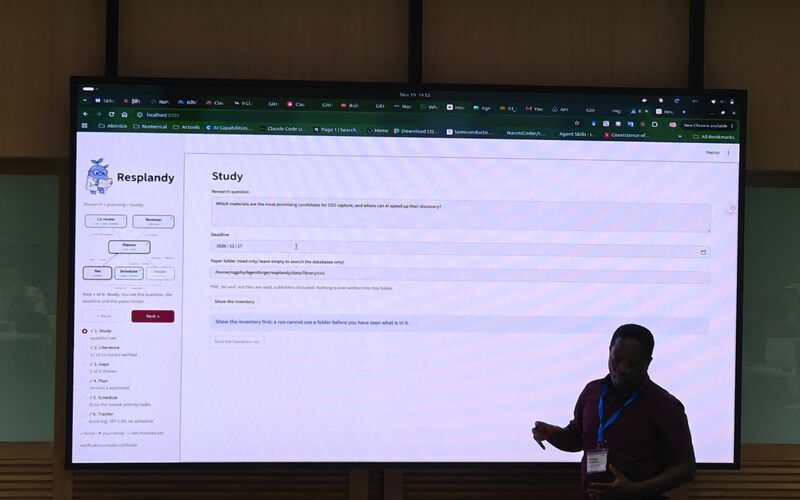
Resplandy
A multi-agent research-planning assistant: agents propose, code checks, you decide.
github.com/rugphy-hub/resplandy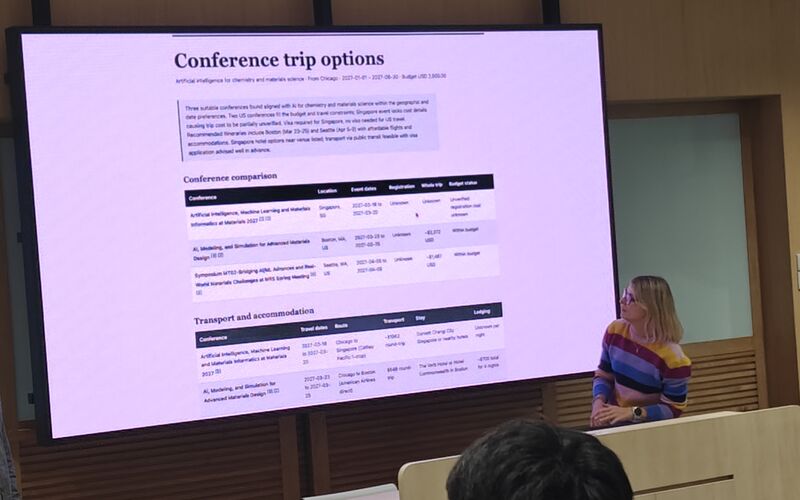
TripPlanner
A multi-agent assistant for planning trips to academic conferences.
github.com/AgentForgeWorkshop/TripPlannerThe organisers also published the Agent Skill they used to review the entries from their repositories: Judgment-Skill.
Build on it
Everything above is open. Use the materials in your own teaching, open an issue or a pull request, or take a hackathon project further for your own research.